Splitting 10s in Blackjack – Why You Shouldn’t Do It
June 30, 2026 Tony ChristopherSplitting 10s in blackjack is one of the strategies that, as an expert I can’t recommend in good faith. When the dealer has a weak upcard, it could improve your chances of winning, but in most scenarios, it will ruin your hand. Nevertheless, this is a risky tactic that experienced gamblers usually avoid. In this blog, I’ll share with you why.
Article contents:
About the Author:
Tony Christopher is a seasoned writer in the online gambling industry, with extensive experience covering casino games and table-game strategy. He combines a solid grasp of the math behind the games with a focus on disciplined, responsible play, offering expert insights into game strategies. Skilled at simplifying complex concepts for players of all levels, Tony’s perspective on blackjack strategy and game psychology makes him a respected voice on the subject.
The Fundamental Rules – Understanding Why Splitting 10s is Discouraged
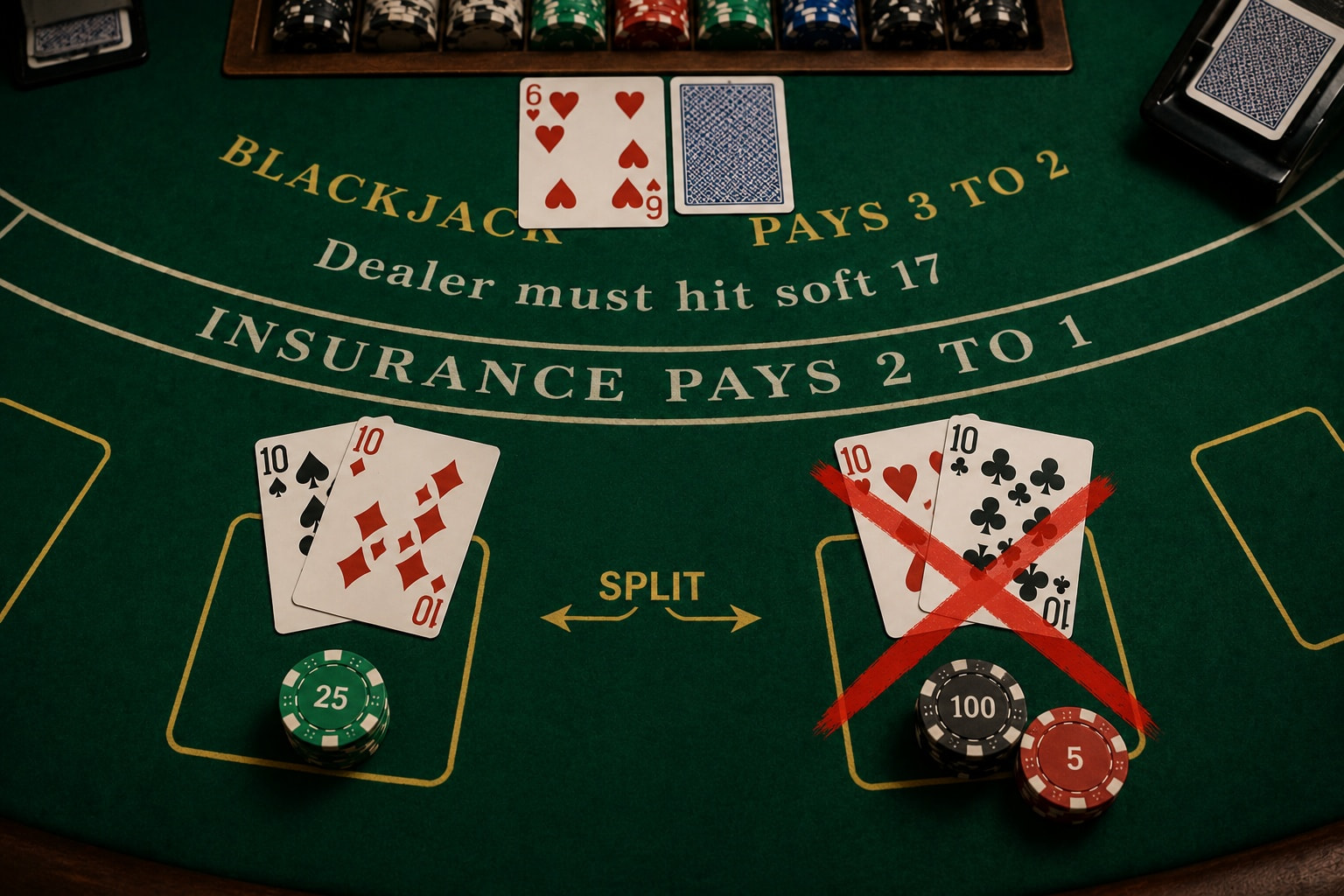
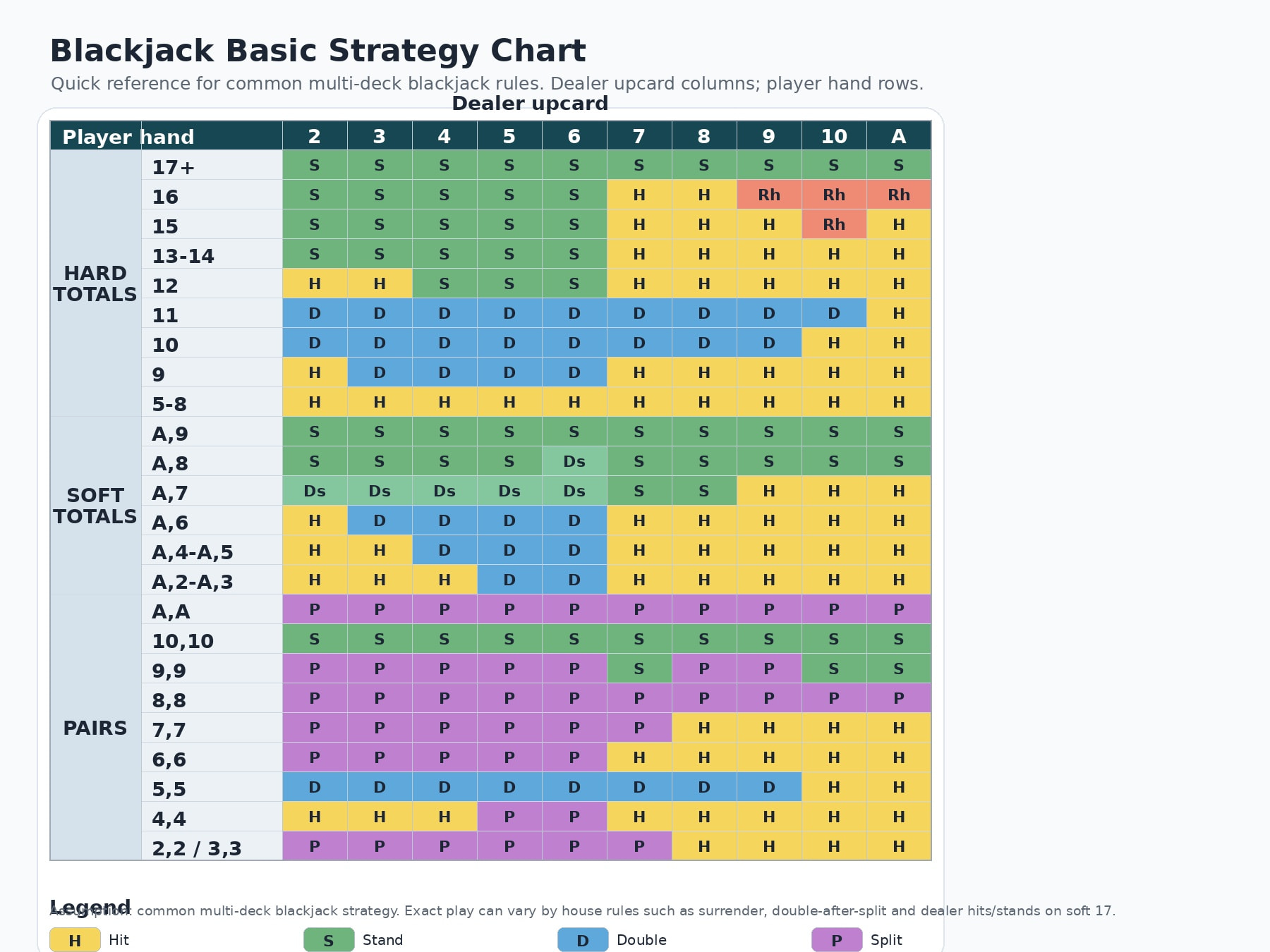
In blackjack, splitting 10s is advised against because, based on the game’s basic rules, a pair of 10s is a very strong hand. It can only be outmatched by the dealer hitting 21, so there’s no need to take additional risks. If you’re starting out, you can use a blackjack hands chart to make the decision process easier.
Opting to split 10s in blackjack creates two hands, each starting with a 10, but this diminishes what’s already a strong position – having a near-certain win with a total of 20. As someone with a love for math, it’s clear to me that the probability of improving upon each split hand to get a score closer to 21 is considerably lower than the likelihood of winning with an unsplit 20.
That’s why splitting 10s is statistically seen as a move that increases risk without a proportional increase in potential reward. If you get this hand, we advise you to stand. This holds true in most situations regardless of the dealer’s upcard. Some players who follow unconventional betting systems might do it, but their strategies are considered less effective.
Analyzing the Odds: The Math Behind the Strategy
Holding a 20 is one of the strongest hands possible. Statistically, a player’s chances of winning with it are approximately 78% to 80%. This probability is so high because the only way a dealer can beat a 20 is by having a 21. However, even in the worst-case scenario, when the dealer’s upcard is an ace, there is only around a 30% chance of this happening.[1]
| Hand | Winning Probability | Probability of Drawing 10-Value Card | Probability of Weaker Hand |
| 20 | 78-80% | N/A | N/A |
| Split 10s – Hand 1 | Varies | 28% | 72% |
| Split 10s – Hand 2 | Varies | 28% | 72% |
When you split 10s, the odds shift. Each new hand, starting with a 10, has about a 28% chance of drawing an ace, king, queen, or jack to make another 20. However, there’s a 72% chance of drawing a lower card, which could result in a weaker hand. The cumulative probability of both split hands being strong enough to win decreases substantially compared to the single strong hand of 20.
Psychological Pitfalls: Overconfidence and Misjudgment
The decision in blackjack to split 10s is often influenced more by the player’s psychology than strategic reasoning. Overconfidence, especially after a series of wins, can lead players to take unnecessary risks.[2] The thrill of gambling and the psychological pitfalls we’ve outlined can cloud judgment, steering players away from safer, more calculated moves.
Psychological Pitfalls Associated with Blackjack:
- Overconfidence
- Gambler’s fallacy
- Confirmation bias
- Risk-taking impulse
- Illusion of control
- Optimism bias
- Escalation of commitment
Sticking to a disciplined strategy is crucial when playing skill-based games. Players who deviate from the basic blackjack rules by splitting 10s are usually enticed by the potential for higher, yet riskier, wins. However, they often find themselves facing larger losses instead. Understanding and respecting the mathematical underpinnings of the game is essential to making decisions that increase the likelihood of long-term success.
Splitting 10s in Online vs. Live Blackjack
In both online and live Blackjack, splitting 10s is not part of the fundamental strategy. However, the different dynamics of these formats can influence how players approach decision-making. That’s why we’ve compared them and explained how various factors, like pacing and the environment,[3] can affect your moves.
| Factor | Online Blackjack | Live Blackjack |
| Game Environment | Solitary, less external pressure | Social, interactive with potential peer pressure |
| Game Pace | Up to the player, so it can be slow or fast | Usually slower, but there might be pressure to make decisions quicker |
| Decision-Making Time | You can take as long as you need, as you’re not playing with real people | Less time for each decision due to the game pace and social aspect |
| External Influences | Minimal; decisions based more on strategy | Higher; influenced by the dealer and other players |
| Strategy Adherence | Easier to stick to a basic strategy like not splitting 10s | Can be swayed by emotions and social dynamics |
| Impulse Decisions | Less likely due to the isolated environment | More likely due to group dynamics and the more authentic casino atmosphere |
| Pressure | Mainly internal, based on personal discipline | External, from the presence and actions of others |
The more solitary and independent pace of online RNG variations might encourage adherence to a strict strategy. Players can also freely use blackjack strategy cheat sheets, which might make the decision process less pressuring for beginners. Meanwhile, the social aspect and influence of other players when playing live might lead to impulsive moves like splitting 10s.
Conclusion – Smart Play for Long-Term Success
To sum up, splitting 10s in blackjack is generally an unwise move. It contradicts basic strategy and statistically reduces the likelihood of winning. Intelligent, disciplined play is the key to long-term success in this game that combines skill and probability. Sticking to proven strategies like holding a strong 20 maximizes winning chances.
References
- Blanchard, H., (May 13, 2019), Blackjack: the math behind the cards, Retrieved January 15, 2024.
- Stone, E., (January 26, 2023), Thinking without knowing: Psychological and behavioral consequences of unjustified confidence regarding blackjack strategy, Frontiers in Psychology, Retrieved January 15, 2024.
- Harris, A. and Griffiths, M.D., (June 22, 2017), The Impact of Speed of Play in Gambling on Psychological and Behavioural Factors: A Critical Review, Journal of Gambling Studies, Retrieved January 15, 2024.